Failure one
COMPUTE WITHOUT DATA
Compute without useful data wastes energy.
One framework that explains where the next generation of wealth, intelligence, and global power will concentrate.
For nearly two decades, I have studied how technology changes markets, how capital moves before the public understands why, and how new systems quietly replace the foundations of the old economy.
The Power Triad is the framework that pulls it all together.
Every major economic era has been built on a few foundational assets. As each era advances, those assets are upgraded and reorganized into the building blocks of the next. Today, the digital economy is converging around three essential inputs: compute, data, and energy.
Artificial intelligence is often described as software, but software is only the visible layer. Beneath every AI model, autonomous machine, financial network, and robotics platform is a physical system converting electricity into computation and computation into intelligence.
Energy powers the system. Compute processes the information. Data teaches the system how to understand, predict, and act upon the world.
Remove any one of them and the entire system weakens.
Compute without useful data wastes energy.
Data without enough compute remains trapped and underutilized.
Compute and data without abundant, reliable energy cannot scale.
Compute capacity can grow faster than the electrical grid required to power it. Data can accumulate faster than the systems needed to verify and process it. A country can possess abundant energy but lack the semiconductors, infrastructure, or institutional capacity required to convert that power into intelligence.
A company with powerful computers but weak data wastes capital. A company with valuable data but insufficient compute cannot unlock it. A nation with both compute and data but unreliable energy becomes dependent on someone else’s infrastructure. The system may appear advanced while remaining constrained by its weakest pillar.
Capital flows toward the constraint because the missing pillar becomes disproportionately valuable.
Power generation, transmission, cooling, and grid infrastructure gain importance.
Semiconductors, data centers, and cloud capacity become strategic.
Proprietary information, sensors, verification systems, and trusted networks become the advantage.
Understanding the Power Triad means looking beyond the technology receiving the most attention and identifying the foundation preventing the entire system from scaling. The greatest opportunities will often exist not in the most visible part of the system, but in the neglected pillar the future cannot advance without.
When I tested the Power Triad against five years of markets, one connection kept showing up that I had not given enough weight. Data does not turn into intelligence where it sits. It has to be stored, then moved into the chips fast enough to keep them working. The part of the system that does that job is memory and storage.
A chip that is waiting for data is a chip doing nothing. The more powerful the chips become, the more the whole system depends on how much data can be held close to them and how quickly it can be moved in. Compute cannot run faster than the data feeding it.
Memory, storage and networking companies earned about 30% of the operating profit across the AI supply chain I studied, from late 2021 to mid 2026. Almost all of it went to memory and storage.
In the first half of 2026 their share passed half of everything the group earned.
In the second quarter of 2026, memory and storage makers earned more operating profit than every AI chip designer, chip factory and chip-printing machine maker in the study combined.
Companies whose main asset is simply owning data captured very little of it over the same years. The value was earned by whoever could store data and move it into the chips. That is why I now look at the Power Triad with a checkpoint inside it: energy powers the chips, the chips do the thinking, and memory decides how much data reaches them. Whichever of those is shortest sets the limit, and sometimes the bottleneck is the bridge itself.
Figures come from my own research into the reports of 36 companies and business units, from the fourth quarter of 2021 to the second quarter of 2026. Past results do not guarantee future results, and nothing here is a recommendation to buy or sell anything.
That changes how wealth must be understood. Traditional assets do not disappear, but their value increasingly depends on how effectively they connect to the Power Triad.
The market still treats energy, semiconductors, data centers, proprietary data, electrical grids, fiber networks, and robotics as separate industries.
They are different layers of the same emerging system: the infrastructure required to manufacture intelligence at scale.
As the global economy becomes more automated, nearly every company, industry, and nation will become a producer, controller, distributor, or consumer of compute, data, and energy. The greatest advantages will belong to those capable of coordinating all three.
When you put it together, you get one framework. Find the bottleneck. Follow the conversion of energy into compute, compute and data into intelligence, intelligence into automation, and automation into productivity and wealth.
I track where the bottleneck sits right now in The Pantoja CDE Framework, updated as new evidence comes in.
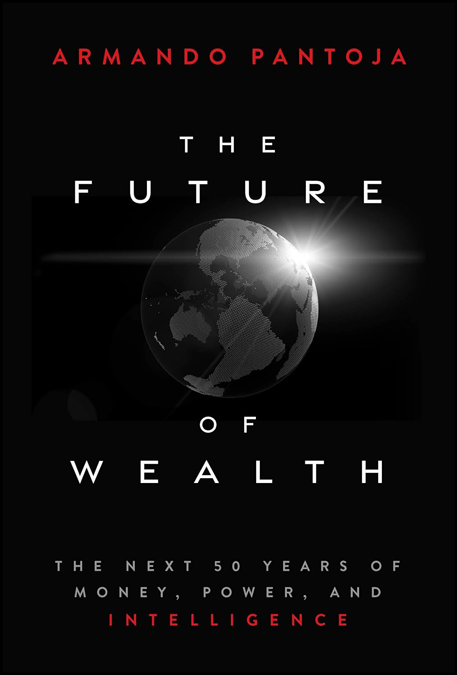
The Future of Wealth explains how the Power Triad will reshape markets, companies, nations, and civilization over the next 50 years, and what individuals must understand to position themselves before the transformation becomes obvious.